
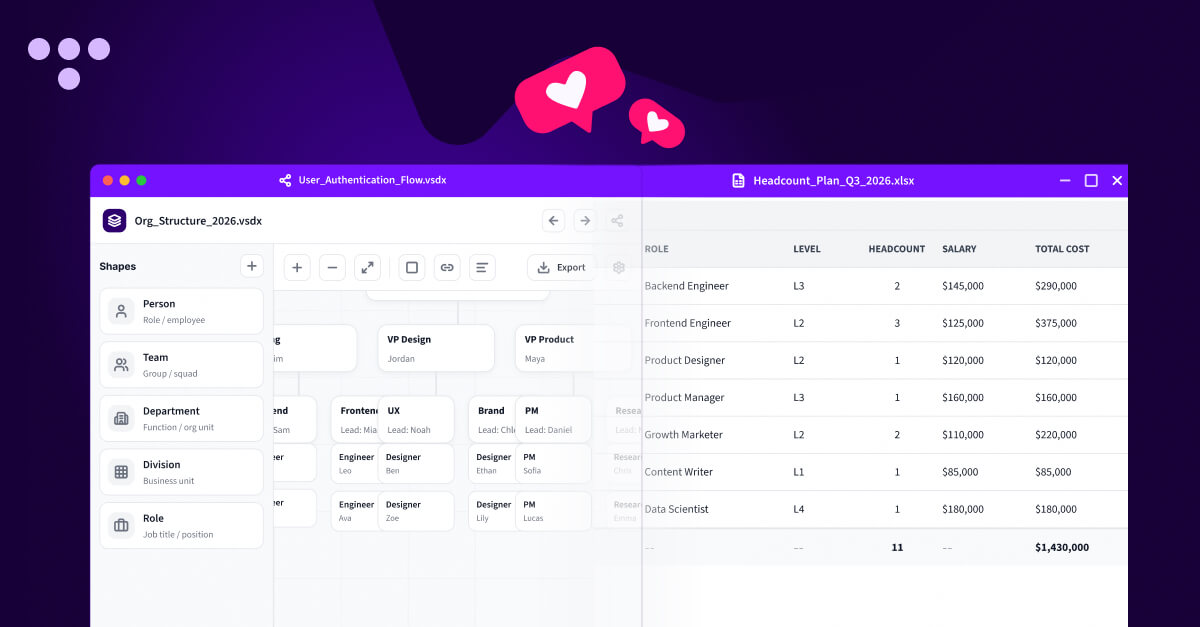

HR builds the org chart. Finance builds the headcount budget. Most companies treat these as two separate projects that happen to be about the same thing: the people in the organization. Then reorg season arrives, the numbers don't match, and both teams spend the next two weeks reconciling spreadsheets instead of planning.
This isn't a communication problem. It's a data problem. HR and Finance are usually working from different systems, different definitions of "headcount," and different update cycles — and neither side finds out where those definitions diverge until a leadership review goes sideways.
Here's how the two workflows actually work, where they're supposed to intersect, and what it takes to plan the org as one process instead of two.
What org planning actually splits into
Org planning isn't one job. It's two jobs that have to land on the same answer.
HR owns structure. Who reports to whom, what teams exist, what roles are open, and how a reorg changes reporting lines. This is org design: spans of control, layers of management, team boundaries, and role definitions.
Finance owns the budget. How many people the company can afford to have, by department, by quarter, against revenue and plan. This is headcount planning: approved requests, cost per role, burn rate, and the ceiling leadership has agreed to.
Both are legitimate, necessary views of the same organization. The trouble starts because they rarely live in the same place. HR structure typically lives in an HRIS or, just as often, in a set of slides someone updates by hand. The headcount budget lives in Finance's planning tool or a separate spreadsheet, built around cost centers and fiscal quarters rather than reporting lines. Neither system was built to talk to the other, so someone has to translate between them manually every planning cycle.
HR's workflow: building and maintaining structure
When HR runs org planning on its own, the workflow usually looks like this:
A department head requests a reorg or a new team. HR maps out the proposed structure — who moves where, who the new manager is, which roles get created or eliminated. That mapping typically happens in a slide deck or a chart tool, disconnected from the HRIS, because most HRIS platforms are built for transactional records (pay, benefits, status) rather than for modeling a structure that doesn't exist yet.
Once the structure is approved, HR updates the system of record — new manager assignments, new team names, updated titles — and that update eventually flows into whatever tool employees actually use to see the org chart. The gap between "the reorg is approved" and "the org chart reflects it" is often measured in weeks, not days.
Unfortunately, there’s a core weakness in this workflow: HR can model structure, but it can't natively see whether that structure fits the budget. A proposed reorg might look clean on a slide and still add three people to the headcount that Finance never officially approved.
Finance's workflow: building and maintaining the budget
Finance's version of org planning runs on a different rhythm, usually tied to the fiscal calendar:
Department budgets get set during annual or quarterly planning, broken into approved headcount by cost center. As the year goes on, Finance tracks actuals against the plan — who's been hired, who's left, what open requests are still outstanding — and flags variance when a department is over or under its approved number.
This workflow lives in cost centers, not reporting lines. Finance can tell you precisely how many people Engineering is budgeted for this quarter. What Finance usually can't tell you, without pulling in HR, is whether "Engineering" in the budget maps cleanly to "Engineering" in the org chart — because reorgs move people between cost centers without always updating the budget model in the same moment, and vice versa.
The core weakness here is the mirror image of HR's: Finance can model the budget, but it can't natively see the structure that budget is supposed to fund.
Where the two collide
Here’s three moments we’ve heard that force HR and Finance to reconcile their separate views, usually under a time crunch and yesterday's deadline.
- Backfills. A role opens up. HR wants to know if it can be filled and under what title. Finance wants to know if it's still in the approved budget. If the answer requires someone manually cross-referencing a headcount tracker against an org chart, the backfill stalls — or worse, gets approved on the HR side before Finance confirms the budget line still exists.
- Reorgs. HR redesigns a team's structure. Every move changes a cost center assignment, and every cost center change affects the budget. A reorg that looks like a one-slide change to HR can quietly break Finance's quarterly model if nobody catches the cost center shift.
- Planning cycles. Once or twice a year, Finance needs department-by-department headcount targets, and HR needs to know what structure it's allowed to build toward. This is the moment the two workflows are supposed to merge — and it's usually the moment where each side discovers the other has been working from a different source of truth.
Data accuracy is the thread running through all three. Not "someone made a typo" accuracy — the deeper kind, where HR's structure and Finance's budget are technically both correct and still don't agree, because they were never built from the same underlying data.
A workflow that runs in tandem
The fix isn't asking HR or Finance to give up ownership of their piece. It's giving both teams a shared, live view of the org that each can model against.
Here's what that looks like in practice, walking through a single reorg:
A VP requests a restructure of two teams under them. HR opens a planning workspace built on the current, live org chart — not a static export from three weeks ago — and models the proposed changes: new reporting lines, consolidated roles, one net-new position. Because the workspace is tied to current headcount data, Finance can see the same draft structure in real time, with the cost center and budget impact of each change laid out alongside it, before anything is approved.
Finance flags that the net-new position pushes Engineering two heads over its approved Q3 number. HR adjusts the plan — delaying the new hire to Q4 rather than cutting it entirely — and both teams sign off on a version of the reorg that's structurally sound and budget-approved on the same day, instead of after a week of email threads.
Once approved, the change updates the org chart directly. Employees see the new structure immediately. Finance's headcount tracker reflects the same reorg without a second manual entry. There's one version of the org, not two that need reconciling after the fact.
This is the difference between HR and Finance planning "in tandem" versus planning "in parallel." Parallel planning means both teams do their own work and compare notes later. Tandem planning means both teams are working from the same live structure, with their own lens on top of it, at the same time.
Where each team still needs its own view
Shared data doesn't mean identical dashboards. HR and Finance need different things out of the same underlying structure.
HR needs a sandbox where it can model a reorg without committing to it — draft reporting lines, test different team configurations, and see the ripple effects (who now has too many direct reports, where a layer got added) before anything goes live.
Finance needs headcount and cost data attached to that same structure, filterable by cost center and fiscal period, so a proposed reorg shows its budget impact automatically instead of requiring a separate export and a manual lookup.
HRBPs, sitting between the two, need both views at once — the structure their business partner is asking for, and the budget reality Finance has approved — so they're not the ones stuck translating between two spreadsheets in a meeting.
What this requires from your systems and tooling
None of this works if structure and budget data live in disconnected tools that only sync when someone remembers to update both. Three things have to be true.
The org structure has to be live, not a slide deck or an export that goes stale the day it's built. Reorg drafts and approved structures need to be modeled in the same place, so nobody is redesigning a team in a slide tool and then re-keying it into the system of record later.
Headcount and budget data need to sit next to that structure, not in a separate tool that requires a manual cross-reference every time someone asks whether a role can be filled.
Both HR and Finance need a shared source of truth they can each build their own view on top of — one org, two lenses, instead of two orgs that occasionally get reconciled.
This isn't just a vendor talking point. Reviewing this year's Top HR Products submissions for HR Executive, Aptitude Research analyst Madeline Laurano made the same argument: as AI reshapes what the work actually is, planning becomes org design rather than a headcount exercise — and that shift is precisely what forces finance and HR onto the same data. Cost, capacity, skills, and scenario modeling, in her framing, can't survive being split across three systems and a spreadsheet.
That last point is where most org chart tools and most headcount planning tools each get half the picture right. Org chart software shows the structure but rarely connects to budget data. Headcount planning tools track the budget but usually can't model a reorg's structural ripple effects before it happens. The gap between the two is exactly where backfill delays, budget surprises, and reconciliation meetings come from.
The two teams, one org
HR and Finance aren't going to merge into one team, and they shouldn't. Structure decisions and budget decisions require different judgment, different stakeholders, and different questions. What they can share is the data underneath those decisions — one live, accurate view of the organization that each team models against, instead of two versions that get quietly reconciled after the fact.
That shift is what actually closes the data accuracy gap. Not a new meeting, not a shared spreadsheet template, but a structure and a budget that are built from the same source and update on the same timeline. When that's in place, a backfill request, a reorg draft, or a planning cycle stops being a negotiation between two sets of numbers and starts being a conversation about one.
Prompts HR and Finance teams can bring to their next planning conversation
The questions below are the ones that tend to surface the gap between structure and budget before it becomes a bigger problem. Use them in your next joint planning session, or as prompts if you're working through a reorg or headcount request with an AI tool of your own.
Before proposing a reorg: "What does this structure cost against the current approved budget, by cost center, and where does it create variance?"
Before approving a backfill: "Is this role still funded in the current budget, and does the reporting line it sits under match what Finance has on record?"
During annual or quarterly planning: "Where do HR's structural priorities for this period conflict with Finance's headcount targets, and which of those conflicts need to be resolved before this goes to leadership?"
When headcount numbers don't match between teams: "What's the source and the as-of date behind each number, and where did the two records diverge?"
When designing a new team or role: "Does this org design fit inside the approved headcount ceiling, or does it require a budget conversation before it's finalized?"
For HRBPs caught between the two: "What would Finance need to see to approve this structure, and what would HR need to see to confirm it's operationally sound?"