
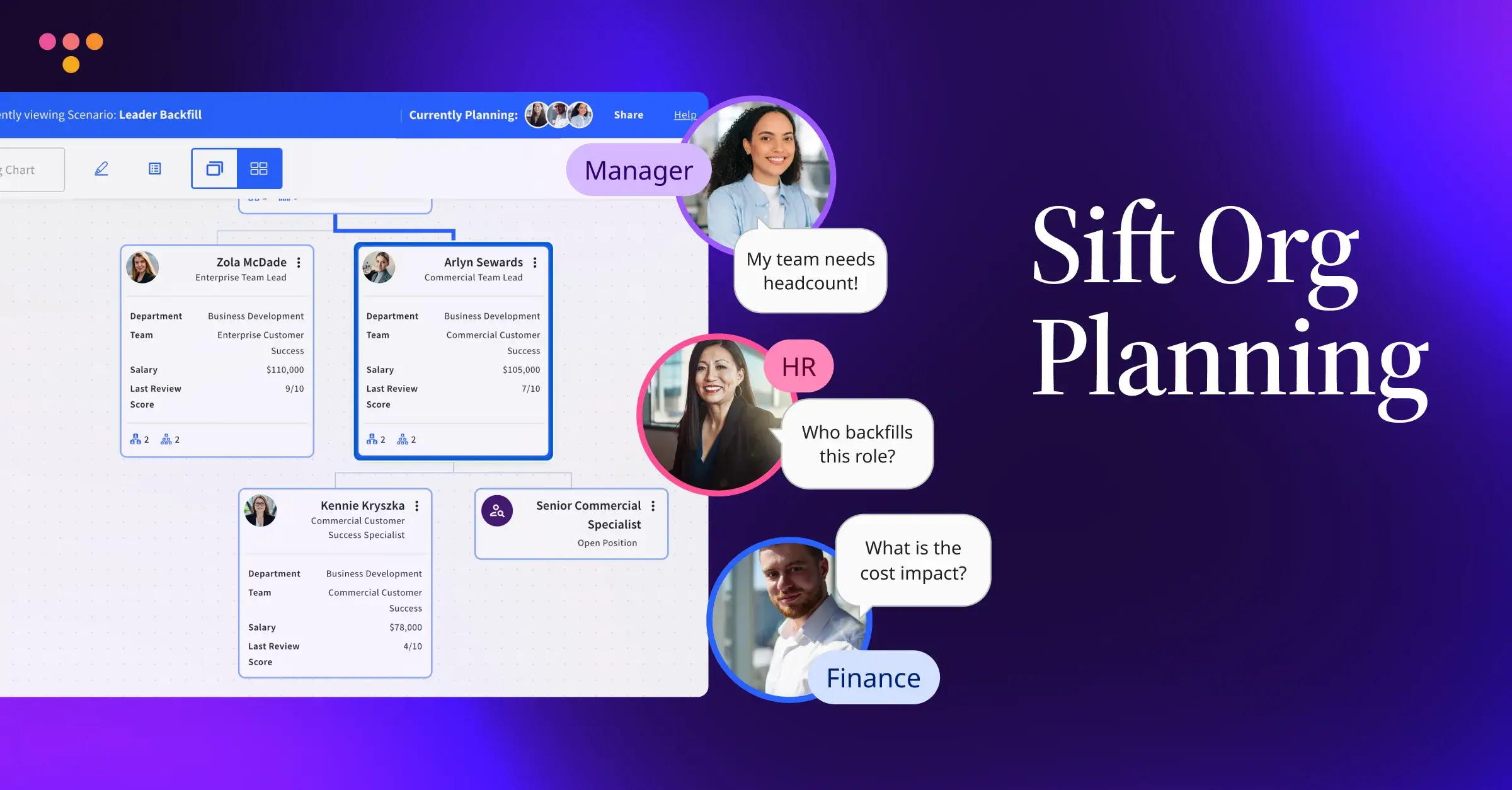
HR teams have always had to leave their org chart to plan the future of their org.
That's the sentence I keep coming back to when I think about why we built Sift Org Planning. The org chart is where everyone goes to understand how the company works today. But the moment someone needs to figure out what the company should look like next quarter, they leave it. They export it, paste it into a slide deck, or rebuild it row by row in a spreadsheet. By the time the plan is ready to share, the organization it was built on has already moved.
Today we're launching Sift Org Planning, and I'm really proud of what our team built. It brings planning back onto the org chart, so the people shaping your company's future can work from a live, accurate picture of the people they're planning for.
Org design is under a different kind of pressure right now
A few big shifts are landing on HR leaders at the same time this year, and each one makes org design harder.
AI is changing what a lot of roles look like, and it's doing it faster than traditional job structures can absorb. As AI takes on more transactional work, leaders are being asked to make confident calls about redeployment, reskilling, and restructuring. That starts with a simple question: what can our people actually do? In most organizations, the honest answer is that nobody knows with enough precision to act on it. A traditional org chart shows who reports to whom. It doesn't show what those people are good at, what they're working on right now, or how their skills connect to where the business is going.
Deals are moving faster too. When an acquisition closes or a restructure is announced, leadership needs clarity right away. Who are the key people? Where do skills overlap, and where are the gaps? What should the combined structure look like? Historically, that picture has taken months to put together, because people data lives in separate systems and the org chart everyone designs against is a slide deck someone maintains by hand.
And the most forward-looking HR teams have started asking different questions altogether. They want to know what capabilities a team needs to deliver on its strategy, where skills are concentrated in ways that create risk, and what a function's capability profile would look like if it moved under a different leader. Those are great questions. They're also impossible to answer from a chart that only shows boxes and reporting lines.
What we heard from HR leaders
The direction for Sift Org Planning came straight out of conversations with HR leaders working through these changes in real time. What struck me most was that the obstacle they described usually wasn't the decision framework. They knew how they wanted to make these calls. What they were missing was the data, in one place, current enough to trust.
Reorgs were being modeled in slides that went stale as soon as someone changed teams. Integration scenarios lived in spreadsheets with no link back to the HR system of record. Skills-based planning meant pulling data from a handful of systems and asking analysts to stitch it together. Every one of those workarounds pulled planning further away from the actual organization.
To every customer who took the time to tell us what was broken: thank you. A lot of what you'll see in Org Planning is your feedback.
Planning that starts with people
Here's the idea at the center of Sift Org Planning. When you move a person in a Sift Scenario, you can see who you're actually moving. Their skills, their experience, and their current projects come with them, pulled from their Sift profile. You're looking at a person with a track record, rather than a box with a title.
That changes the quality of the decision. If you're redesigning a team because AI is taking over some of its work, you can see who has the background to step into what comes next. If you're modeling a combined org after an acquisition, you can see where expertise doubles up and where it runs thin. Having that context in front of you, alongside headcount and cost, is what makes a planning decision defensible rather than directional.
If you can read an org chart, you can plan with it
One thing we cared about from day one: Org Planning had to be easy enough for anyone who'd be part of a change to pick it up. Org planning has long been treated as a specialist job for HR and a couple of analysts. In practice, the people who understand a team best are often the managers running it, and they deserve a seat at the table without having to learn a new tool to get there.
So Org Planning works the way the Sift Org Chart already works. You create a Scenario from your current org, then drag people and positions to where you think they should go. Hover over a card to see what you can do with it. Need a role that doesn't exist yet? Add it. Not sure where someone fits? Set them on the Bench while you work it out. As you make changes, the Summary updates to show the impact on headcount, and on compensation if your organization has turned salary data on.
A manager doesn't need special planning permissions to take part, either. Whoever creates a Scenario can share it with the people who should weigh in, and those people can view it, edit it, and leave comments right on the cards they have thoughts about. For a lot of managers, that'll be the first time they've been invited into a reorg while it was still a draft instead of hearing about it after the fact.
Planning together, before anything is announced
Too often, a restructure gets designed by a small group behind closed doors and then presented as a finished decision. We wanted to make org design a shared process that still stays confidential.
With Sift Org Planning, a head of engineering can see exactly how a proposed team consolidation affects their function. A finance business partner can watch headcount and labor cost shift as changes are made. An HR business partner can flag a skills gap in a proposed structure before it turns into a problem after the announcement. Everyone works in the same scenario, sees changes as they happen, and can check the activity log for what changed and who changed it. No more version 11 of a deck making its way around by email.
Built on data you can trust
A plan is only as good as the data underneath it. Sift holds certified integration partnerships with Workday and UKG. That means every Scenario starts from live, accurate people data instead of a manual export or a spreadsheet that was current last quarter. Sift is built to complement the HRIS you already run, so your system of record stays exactly where it is while your team gets a better place to plan.
Where we want this to go
I'd love for org design to feel less like a once-a-year event that happens in secret and more like an ongoing conversation between HR, Finance, and the managers who run each team. The next few years are going to ask a lot of organizations, and the ones that handle it well will be the ones that can see their people clearly and plan around what those people can do.
Sift Org Planning is our first big step in that direction, and we're just getting started.
See it with your own org
Sift Org Planning is available now to existing customers and as part of Sift's product offering. If you're already using Sift, our Help Center article on getting started with Sift Org Planning walks you through your first scenario.
If you're working through AI-driven role changes, an acquisition, or a move to skills-based design, request a demo with your actual org data. Seeing your own people in a scenario is the fastest way to understand what this can do.