
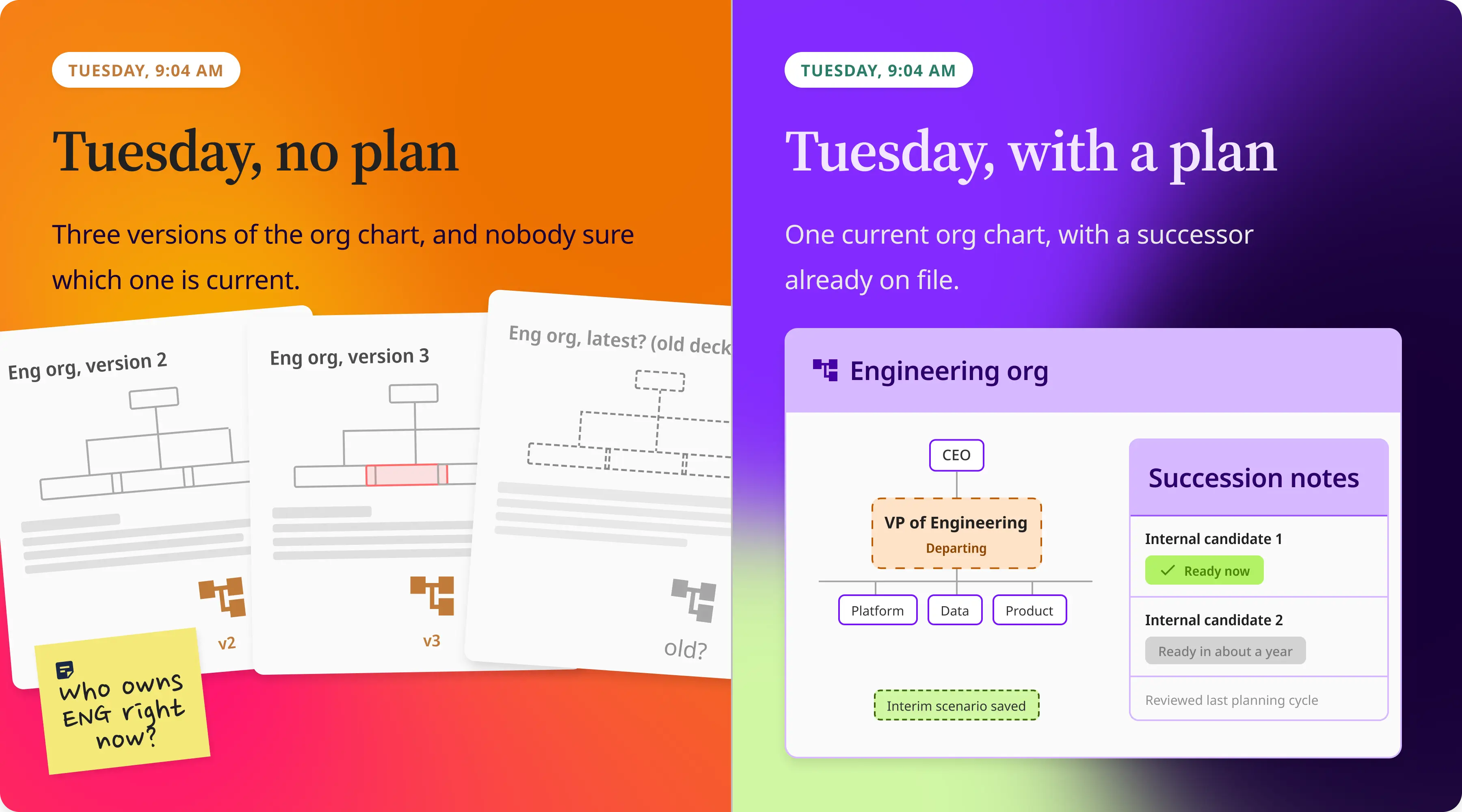

It's a Tuesday morning when your VP of Engineering gives notice. Two weeks, effective immediately after that, and she's already got an offer signed somewhere else.
You liked her. She was good at her job. And now you're staring at an org chart that (if you're honest) hasn't been touched since the last reorg eight months ago.
This is the scenario a lot of HR leaders and executives know a little too well. Let's walk through how it usually plays out, and then what it could look like instead.
The Scramble: a realistic timeline
Day 1: The news lands.
The VP tells her manager, who tells the CHRO, who tells the CEO. Everyone agrees this is bad timing. Everyone always agrees it's bad timing, because there's no such thing as good timing for a departure like this.
Day 2: The search for a plan.
"Did we ever document a succession plan for this role?" Bouncing between an email chain and a Slack thread, the answer is somewhere between "sort of" and "not really”. Someone brings up a slide from a leadership offsite eighteen months ago that names a potential successor. And that person left the company four months later.
Day 3-5: The org chart hunt.
HR pulls together the reporting structure to figure out who's affected. This means opening three different spreadsheets, because the "official" one in the shared drive is two versions behind what Finance has, and neither matches what the engineering team deems as current. Someone else finds a fourth version from a slide deck shared last quarter that's somehow more accurate than both?
Week 2: The interim decision.
Leadership picks an interim lead, usually the most senior engineering manager with the most leadership visibility, without a clear sense of whether that person actually wants the job or has the standing with the rest of engineering to make it work. It's the fastest option available, not necessarily the best one, so they make do.
Week 3-6: The ripple effects.
Two direct reports start quietly interviewing elsewhere, unsettled by the uncertainty and lack of transparency through the seachange. A cross-functional project stalls because nobody's sure who owns the decision anymore. The interim lead is stretched by the two jobs. They begin to feel overwhelmed by this rapid change and they’re not handling it very well. HR starts fielding questions from the rest of the org: who's actually in charge of engineering right now?
Month 2: The external search.
The company finally opens a formal search for a permanent VP, four to six months out from a hire, during which the org runs on the interim structure that was never meant to be permanent. The team’s confidence during this time starts to fracture and there’s a noticeable friction towards the business goals and leadership’s management.
None of this is dramatic. It's not a crisis in the traditional sense. It's just slow, expensive uncertainty, stacked on top of the very real cost of losing a leader in the first place.
What The Scramble actually costs
Nobody puts a line item on the calendar that says "cost of not having a successor ready." It doesn't show up that cleanly. It shows up as a string of smaller costs that stack on top of each other until the whole thing is more expensive than anyone budgeted for.
Start with the search itself. Recruiting a VP of Engineering from outside isn't a fast or cheap process under the best conditions, and these aren't the best conditions. It's happening under pressure, with an interim structure that everyone knows is temporary, which tends to narrow the candidate pool to people willing to walk into that uncertainty.
Then there's the ramp. Even the strongest external hire needs months to understand the codebase, the team dynamics, the half-finished projects, and the political terrain that an internal candidate would have already known walking in. That ramp time isn't idle. It's months of decisions made slower, or made by someone still learning who to trust and what's actually going on.
And then there's the version of this that doesn't get talked about enough: the hire that doesn't work out. Six months in, it's clear the fit is off, the team isn't responding to the new leadership style, or the person oversold their experience in the interview process. Now there's an offboarding, another search, another ramp period, layered on top of the first one. The org is right back where it started, except more tired and further behind.
Underneath all of that is the cost that's hardest to see and easiest to underestimate: what the team experiences while all of this is happening. The engineers who start quietly interviewing elsewhere because the uncertainty feels like a signal. The institutional knowledge that walked out the door with the original VP and was never really captured anywhere. The cross-functional partners who stop trusting engineering's timelines because nobody's been steering long enough to make a promise stick.
None of this needs a dollar figure attached to land. Anyone who's sat through a leadership transition already knows how to do that math in their head, and the number they land on is usually higher than what shows up on paper.
Why this keeps happening
Succession planning tends to live in one of two places: a slide from an offsite that gets stale within a quarter, or nowhere at all. Both come from the same root problem. Org structure and succession thinking live in disconnected, static tools that nobody updates unless there's a scheduled reason to.
The org chart is a snapshot from whenever someone last exported it. The successor notes are on a slide that's been forgotten since the meeting that produced it. And when the moment actually comes, the first task isn't succession planning. It's forensic reconstruction: figuring out what's even true about the org before you can plan anything.
By the time you know who reports to whom, who's ready to step up, and what the gaps are, the interim decision has usually already been made out of necessity, not preparation.
The Game Plan: a preferred timeline
Now imagine the same Tuesday morning, but there’s a living org chart that fuels a prepped succession plan from the same data, not a slide that hasn't been opened since the offsite.
Day 1
The VP gives notice. HR pulls up the current org structure, which reflects who's actually in the role today, not a version from eight months ago. Under the VP's position, there's a documented note on potential successors, reviewed at the last leadership planning cycle and kept current since.
Day 1, same afternoon
Leadership reviews the readiness notes on the two internal candidates flagged as potential successors. One is closer than expected. There's a real conversation instead of a guess made under pressure.
Day 2
HR models a short-term interim structure directly against the current org, seeing exactly which teams and projects would be affected and who else might need to shift responsibilities temporarily. This isn't a new spreadsheet built from scratch. It's a scenario built on top of a structure that was already accurate.
Week 1
The interim lead is named with a clear picture of scope, and everyone downstream can see the updated reporting lines immediately, instead of hearing about the change secondhand or through a delayed email.
Week 2 onward
The external search runs in parallel, but the org isn't in limbo while it happens. There's a documented, visible plan, and people can see it.
The departure is still disruptive. Losing a strong leader always is. But the disruption is contained to what it has to be, not multiplied by weeks of reconstructing information that should have already been current.
What this actually takes
Being ready for this moment isn't about predicting who's going to leave and when. It's about a few habits that most orgs know they should have and rarely build:
- A single source of truth for the org chart, every time you need it. Not a slide, not a spreadsheet with three competing versions, but a structure that reflects reality because it's updated as changes happen, not reconstructed or dug up when something goes wrong.
- Succession notes attached to the roles themselves, not a separate slide deck. If the thinking on potential successors lives within the position in the org structure, it doesn't go stale the way a one-time offsite exercise does (a sticky note in the trash bin).
- A habit of reviewing key roles regularly, not just after someone leaves. Even a light quarterly check on critical roles and readiness beats a scramble every time.
- A way to model interim scenarios quickly. When the moment comes, you shouldn't be building a new structure from scratch. You should be adjusting one that's already accurate.
This is where a shared planning layer fits in. Keeping org structure current and succession notes attached to roles means the information leadership needs is already there when a departure happens, instead of something that has to be pieced together under pressure.
How Sift handles this
Sift works alongside your succession planning process rather than replacing it. What it adds is the view you need to plan ahead. You can see everyone who reports to a key leader, directly or through a dotted line, and model what the team looks like if that person moves on. Draft the Scenario where an internal candidate steps up, and you’ll also see the seat they leave behind before it becomes its own emergency. When the two weeks’ notice does arrive, you’re working from a plan you already sketched.